

Trucking Accident Lawyer in Riverside
A Riverside trucking accident lawyer specializes in cases involving commercial motor vehicles — tractor-trailers, Class 8 big rigs, and motor carriers operating under federal FMCSA and DOT rules. The first 72 hours after a crash are critical: that's when preservation letters go out to secure ELD data, driver logs, CSA scores, and maintenance records that the trucking company controls. Without immediate preservation action, that evidence legally disappears. A commercial truck attorney knows federal hours-of-service violations, evaluates driver qualification files and DOT physicals, examines post-crash drug screens, and identifies all liable parties — the driver, the motor carrier, the shipper, the broker, and the trailer owner. Riverside's location on the I-10 and I-215 corridors makes it a high-volume trucking route, and crashes here often involve multi-party liability and serious injury. Settlement values depend on federal compliance gaps, driver negligence, and motor carrier-level safety failures.
What a Riverside Trucking Accident Lawyer Does
A commercial truck accident attorney in Riverside handles cases that involve federal motor carrier regulations, which differ fundamentally from passenger-vehicle negligence claims. Your lawyer must understand FMCSA rules, DOT compliance, ELD (electronic logging device) data, CSA (Compliance Safety Accountability) scoring, and the federal hours-of-service limits that govern driver fatigue.
The lawyer's job starts immediately after a crash. Within 48 hours, a preservation letter goes to the motor carrier, the trucking company, and the insurance carrier. This letter stops the legal clock on evidence destruction. Trucking companies are allowed to purge data after 15 days in many circumstances, but a preservation letter from counsel freezes that timeline and creates a legal duty to retain ELD records, driver logs, dispatch communications, maintenance records, bill of lading data, and the driver's qualification file.
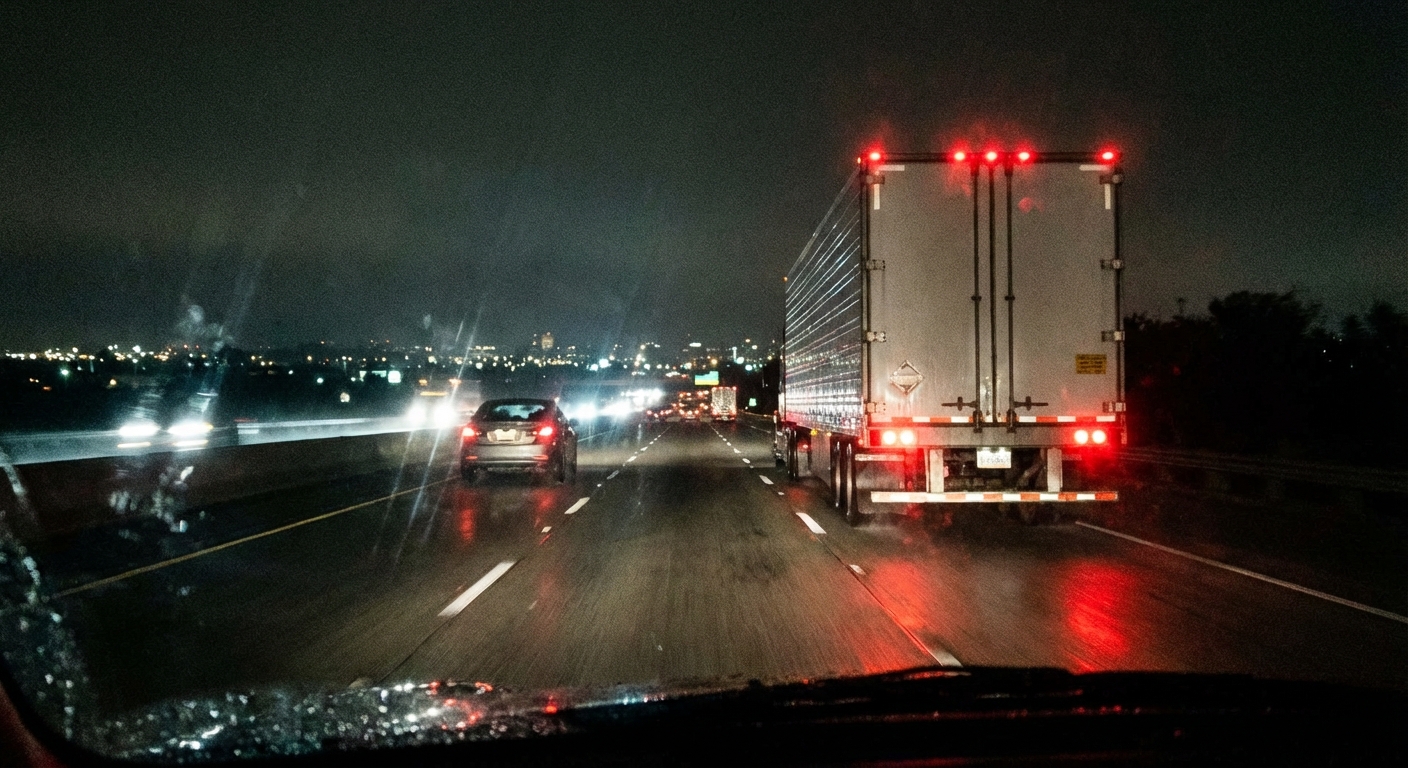
A commercial truck lawyer also evaluates the crash location and context. Riverside sits at the intersection of the I-10 and I-215 corridors, two of California's highest-volume commercial trucking routes. Crashes in these zones often involve heavy loads, complex traffic patterns, and multiple liable parties. The attorney's job includes identifying not just the driver but also the motor carrier, the shipper, the freight broker, the loader, and the trailer owner — each of whom may have independent negligence liability.
Your attorney will request and analyze: the driver's qualification file and DOT medical certificates, the vehicle's inspection and maintenance records, the motor carrier's CSA score and FMCSA safety record, the ELD data showing hours of service and location, and any post-crash drug screen results. Federal violations — such as operating beyond the 11-hour driving limit or failing required vehicle inspections — establish negligence as a matter of law in many cases.
Evidence Preservation and Why the First 48 Hours Matter
Commercial trucking evidence is different from a fender-bender accident report. The trucking company legally controls the evidence: ELD data, driver logs, communications, dispatch records, and maintenance files. All of this lives on servers that the motor carrier can (and will) delete if a preservation letter doesn't arrive immediately.
Here's the timeline: a crash occurs. Within 72 hours, your attorney must send a preservation letter to the trucking company, the insurance carrier, and any third-party liability carriers (shipper, broker, etc.). This letter creates a legal hold on evidence and establishes that any subsequent destruction could constitute spoliation — a severe sanction in litigation that can result in a "default" judgment against the trucking company.
What evidence gets preserved? ELD data showing the driver's hours, location, and vehicle movement in the 24 hours before the crash. Driver logs (which may conflict with ELD data — a critical discrepancy). Dispatch communications and routing instructions. Maintenance and inspection records showing whether the vehicle was roadworthy. The driver's qualification file, which includes his DOT medical certificate, training records, and prior accidents. Post-crash drug and alcohol screening results. CSA scores and the motor carrier's FMCSA safety record.
Without preservation, that data is gone. The trucking company can legally delete ELD records after 90 days (federal FMCSA rule), and many delete much sooner. A preservation letter freezes that clock and creates liability for destruction. In many jurisdictions, destruction of evidence after a preservation letter is served allows a jury to draw a negative inference — essentially, the jury can assume the destroyed evidence would have proven the trucking company's negligence.
A Riverside attorney who doesn't move within 48 hours risks losing the evidence that could win the case.
Talk to a truck accident lawyer today
Free consultation — no fees unless your case wins.
Get started →Federal Trucking Regulations and Negligence
Commercial motor vehicle regulations exist at the federal level. The FMCSA (Federal Motor Carrier Safety Administration) sets rules that every motor carrier must follow. When a trucking company violates these federal rules and a crash results, the violation often establishes negligence per se — meaning the negligence is proven automatically, without requiring additional evidence of fault.
The most common federal violation in truck accidents is hours-of-service (HOS) violations. Federal law limits a CMV driver to 11 hours of driving time after 10 consecutive hours off-duty. A driver cannot drive more than 14 consecutive hours without a 10-hour break. If the crash happened in hour 12 of driving, that's a federal violation and it strengthens the negligence claim significantly. The driver's qualification file includes HOS violations from previous jobs and citations from prior DOT inspections.
CSA (Compliance Safety Accountability) scores are public. The FMCSA publishes a safety rating for every registered motor carrier. A motor carrier with a CSA score above the intervention threshold in unsafe driving, hours-of-service violations, or vehicle maintenance shows a pattern of non-compliance. This score is admissible evidence of negligence and can support a direct negligence claim against the carrier itself, not just the driver.
DOT physicals are required annually for commercial drivers. A DOT medical certificate that has expired, or one showing the driver has a disqualifying medical condition, establishes the trucking company's negligence in hiring or retaining that driver. A driver with uncontrolled diabetes, sleep apnea, or cardiac arrhythmia who was not medically fit to drive is a liability vector for the motor carrier.
Vehicle maintenance and inspection records matter under the Federal Motor Carrier Safety Regulations (49 CFR Part 396). A motor carrier must conduct pre-trip inspections and maintain records. If brake failure, tire failure, or steering failure caused the crash, and maintenance records show the company knew about the defect and failed to repair it, that's direct negligence by the motor carrier.
Gross Vehicle Weight Rating (GVWR) violations also appear frequently. If the vehicle was overloaded beyond its GVWR, that affects braking performance and stability. An overloaded truck that jackknifed on the I-10 is evidence of carrier-level negligence in accepting the load.
Liability in Riverside-Area Trucking Crashes
A single truck accident in Riverside often involves multiple liable parties. The driver was at the wheel, but the trucking company hired the driver, maintained the vehicle, and dispatched him on a route. The shipper may have overloaded the cargo. The freight broker may have failed to vet the carrier's safety record. The trailer owner may have leased defective equipment. Each party can have independent negligence liability.
The motor carrier is almost always liable. Under federal transportation law and California tort law, the motor carrier (the trucking company that holds the FMCSA operating authority) is responsible for the safety of its drivers, the maintenance of its fleet, and compliance with federal regulations. If the driver violated HOS rules, the motor carrier hired a negligent driver. If the vehicle had a mechanical defect, the motor carrier failed to maintain it. Proving motor carrier negligence often opens the path to higher damages because corporations have insurance and deeper pockets than individual drivers.
The shipper and freight broker are liable if they knew or should have known that the motor carrier had a poor CSA score, a history of accidents, or a pattern of safety violations. A shipper who entrusts freight to a motor carrier with a documented bad safety record is committing negligence. The duty is not absolute — the shipper isn't required to vet every carrier — but a publicly available CSA score showing intervention thresholds in unsafe driving or vehicle maintenance makes it hard to claim ignorance.
The trailer owner may be liable if the trailer had a mechanical defect (bad brakes, bad suspension, defective lights) that contributed to the crash. Trailer owners are sometimes separate entities from the motor carrier, and they must maintain their equipment to federal standards.
In Riverside County, cases are filed in the Riverside County Superior Court (4050 Main Street, Riverside, California). California applies pure comparative negligence, meaning a plaintiff can recover even if they are 99% at fault — they recover 1% of their damages. This rule favors truck accident plaintiffs because even if the plaintiff is partially at fault (e.g., merged unsafely), they can still recover from the negligent motor carrier.
Multi-party liability also means multiple insurance carriers. The motor carrier's primary liability insurance, the trailer owner's liability policy, shipper indemnity, and broker errors and omissions insurance are all potential sources of recovery. A Riverside attorney must identify and serve all potential defendants within the statute of limitations window.
Choosing a Trucking Accident Attorney in Riverside
Not all personal injury lawyers understand commercial trucking regulations. Hiring the wrong attorney can mean missing critical evidence, failing to preserve federal data, or undersettling a case with multi-party liability. A Riverside trucking accident lawyer should meet specific criteria.
First, the attorney must have federal trucking law expertise. Commercial motor vehicle cases turn on FMCSA regulations, DOT compliance, and federal transportation law. The attorney should be able to read an ELD data file, interpret a CSA score, and explain what a driver qualification file contains. General personal injury lawyers often lack this technical depth.
Second, the attorney must move fast on evidence preservation. A skilled commercial truck attorney will send preservation letters within 48 hours of taking the case. This is not optional — it's the foundation of a strong case. Ask a potential attorney: what is your preservation protocol, and can you commit to a 48-hour timeline?
Third, the attorney should have experience with multi-party litigation. A trucking accident case often involves discovery against the motor carrier, the shipper, the broker, and the trailer owner. This requires coordinating multiple discovery schedules, depositions, and settlement negotiations. A solo practitioner may lack the resources.
Fourth, the attorney should understand settlement dynamics in commercial truck cases. Liability insurance for motor carriers often reaches $1 million or more. Truck accident cases frequently settle for six figures or more, depending on injury severity, liability strength, and jurisdiction. An attorney who has handled multiple commercial truck cases will have benchmarks for what a case is worth and how to negotiate with insurance carriers.
Fifth, consider location and accessibility. A local Riverside attorney has familiarity with the courts, the judges, the insurance carriers who insure local trucking companies, and the traffic patterns on the I-10 and I-215 that make Riverside a trucking hub. A lawyer who understands the local context is often more effective than a distant firm.
Final question: does the attorney specialize in trucking accident law, or is this a sideline? Trucking is a niche within personal injury. The best outcomes come from lawyers who have made it their focus, not their occasional case.
Common questions
What is the statute of limitations for a trucking accident claim in California?
California Code of Civil Procedure § 335.1 sets a two-year statute of limitations for personal injury claims, including trucking accidents. The clock starts on the date of the injury. Missing this deadline bars the claim forever. Preservation of evidence and early attorney engagement are critical because evidence can disappear within days, even if the legal deadline is years away.
Can I sue the trucking company directly, or only the driver?
You can sue both. The driver is the person who caused the crash, and the motor carrier (the trucking company) is liable for the driver's negligence under the doctrine of respondeat superior. In many cases, the motor carrier has independent negligence liability: hiring an unqualified driver, failing to maintain the vehicle, or operating a fleet with a poor safety record. Direct claims against the motor carrier often yield higher settlements because corporations have deeper insurance coverage than individual drivers.
How much is my truck accident case worth?
Settlement values depend on injury severity, liability strength, and the defendant's insurance. Minor injuries may settle for $50,000–$150,000. Moderate injuries (broken bones, multiple surgeries) often settle for $250,000–$750,000. Severe injuries, permanent disability, and wrongful death claims can exceed $1 million. Federal trucking violations, poor CSA scores, and clear motor carrier negligence strengthen settlement value. An attorney experienced in commercial truck cases can provide a more specific range after reviewing your injury documentation and the evidence.
What should I do immediately after a truck crash?
Call 911 and report the crash to local law enforcement. Do not admit fault or discuss the accident details with the trucking company representative at the scene. If you are able, take photos of vehicle damage, the crash scene, road conditions, and the other vehicle's information (license plate, driver name, trucking company name if visible). Seek medical attention immediately, even if injuries seem minor — some injuries emerge hours or days later. Retain a trucking accident attorney within 24 hours so a preservation letter can be sent to stop evidence destruction.
Are there caps on damages in California trucking accident cases?
California does not cap economic damages (medical bills, lost wages, future care costs) in personal injury cases. Non-economic damages (pain and suffering) are also not capped. This contrasts with some other states that limit pain-and-suffering awards to a fixed amount. The absence of caps makes California a favorable jurisdiction for truck accident plaintiffs, particularly in severe injury or wrongful death cases.
How long does a trucking accident case typically take to resolve?
Simple cases with clear liability and minor injuries may settle within 6–12 months. Complex cases with multiple defendants, federal violations, and serious injuries typically take 18–36 months. Most settle before trial, but some proceed to a jury verdict. A Riverside attorney can provide a timeline estimate after evaluating the case specifics and the defendant's settlement posture. Early settlement often depends on strong evidence preservation and a well-documented damages claim.
Experienced truck accident attorneys. No upfront cost.
Free consultation →