

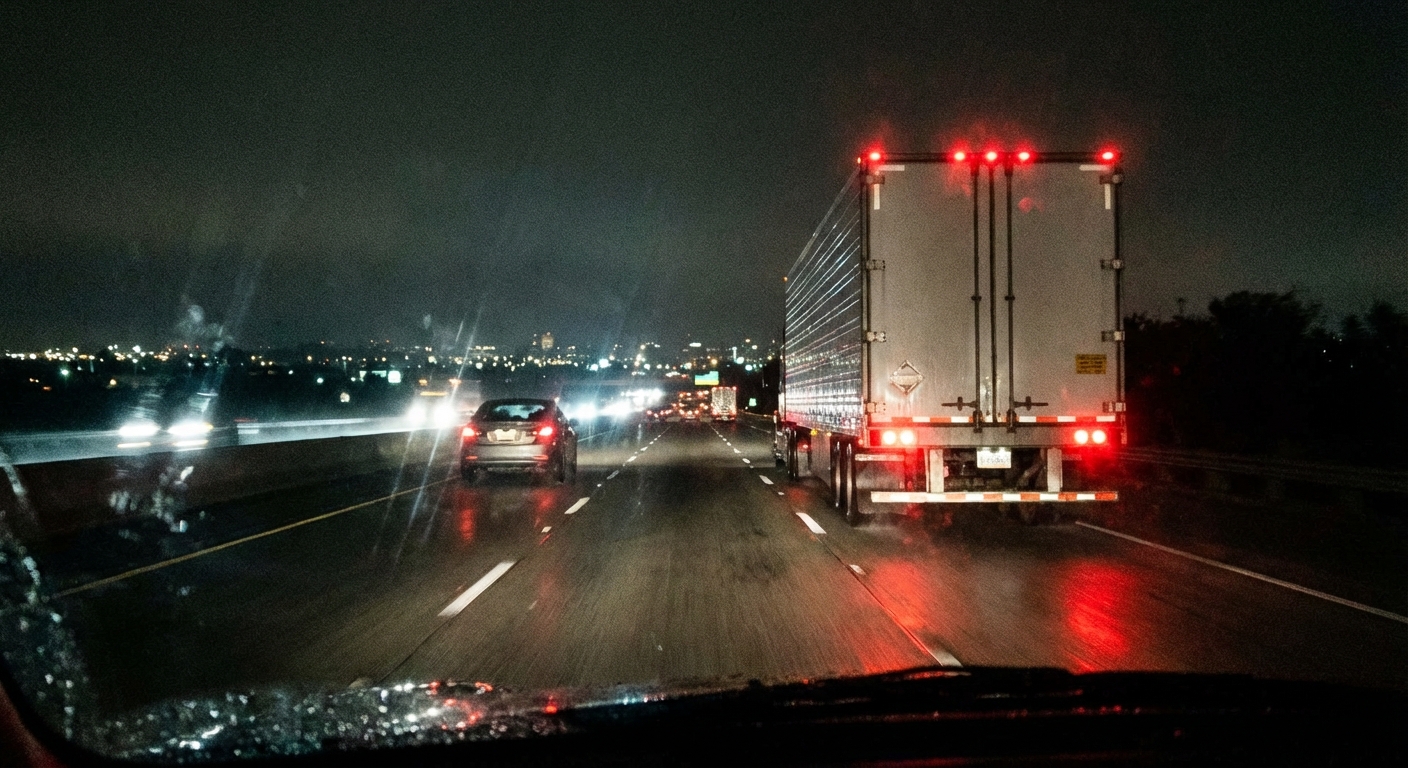
Catastrophic Truck Accident Injury Attorney: What You Need to Know
A catastrophic truck accident—one involving an 80,000-pound commercial motor vehicle against a passenger car—produces injuries that fundamentally change lives. An attorney handling these cases must understand federal hours-of-service (HOS) violations, electronic logging device (ELD) data, CSA scores, and the preservation obligations that trucking companies try to dodge. The defendant's insurer will argue the crash was unavoidable; your legal team must have the technical knowledge to challenge that narrative with ELD download data, post-crash drug screens, maintenance records, and dispatch communications. The financial stakes in catastrophic truck accident cases often reach seven figures. Legal strategy must start before negotiations begin—with a preservation letter that stops the trucking company's erasure of critical evidence.
Major Trucking Routes Where Catastrophic Accidents Cluster
Catastrophic truck accidents aren't randomly distributed. They concentrate on specific corridors where volume is high, congestion creates stop-and-go conditions, and mechanical stress pushes equipment to the breaking point. Interstate 95, running from Maine to Florida, carries the highest concentration of commercial vehicle traffic east of the Mississippi. [NHTSA crash data](https://www.nhtsa.gov/) shows that truck-involved fatalities on I-95 exceed the national average by a significant margin. Interstate 40 stretches 3,073 miles from Barstow, California to Wilmington, North Carolina, serving as the primary cross-country route for freight movement. Trucking companies push hard on I-40—the economic pressure to move loads quickly creates conditions where driver fatigue, HOS violations, and maintenance shortcuts converge into preventable accidents.
Other high-risk corridors include I-10 through Louisiana and Texas (petrochemical and port drayage traffic), I-70 through the Midwest (agricultural and manufactured goods), and I-5 through California (agricultural products and international trade). Port cities see disproportionate catastrophic accident rates because drayage drivers operate on compressed schedules under extreme time pressure. These aren't accidents waiting to happen—they're the result of predictable patterns: driver fatigue violations, inadequate maintenance, and corner-cutting that the driver qualification file, CSA score, and maintenance records eventually expose.
What to Do at the Scene of a Catastrophic Truck Accident
The first hour after impact determines what evidence survives. Here's what you must do and why attorneys depend on it later.
Immediate actions:
- Call 911. Document the exact location—mile marker, street intersection, landmarks. Request law enforcement document the scene before any vehicle is moved.
- Photograph the commercial vehicle's license plate, DOT number, and company markings. Take photos from multiple angles showing roadway condition, visibility, lighting, traffic signs, and final resting positions of both vehicles.
- Note weather, time of day, traffic density, and visible vehicle damage from a safe location. Do not move from the impact zone until law enforcement has documented the scene.
- Do NOT speak with the truck driver beyond exchanging basic information. Do NOT accept settlement offers or sign anything at the scene.
Preserve evidence immediately:
- The motor carrier controls the vehicle once it's towed. Within 24 hours, send a preservation letter (email and certified mail) to the trucking company and its insurer, demanding preservation of: the vehicle's ELD data, black box and telematics recorder, maintenance records for the previous 12 months, driver qualification file (DQF), post-crash drug screen results, and dispatch communications. This stops the legal clock on spoliation.
- Contact a truck accident attorney before speaking with the defendant's insurance adjuster. Adjusters control the narrative and minimize liability exposure by securing evidence. You need an attorney on record immediately to protect your rights.
- Medical records matter immediately. Injuries that seem minor at 24 hours often worsen dramatically. Request all emergency records and ensure your medical provider documents the mechanism of injury, impact severity, and condition immediately post-crash.
Talk to a truck accident lawyer today
Free consultation — no fees unless your case wins.
Get started →Federal Evidence Preservation and Spoliation Law
The FMCSA requires motor carriers to maintain specific records for defined periods. Violating that obligation creates liability separate from the accident itself. Understanding preservation law is what separates specialists from generic personal injury attorneys.
FMCSA retention standards:
- Driver qualification files: 3 years after driver separation
- Maintenance and inspection records: 1 year
- Electronic logging device records: 6 months
- Post-crash drug and alcohol test results: 1 year
Once litigation becomes foreseeable, the trucking company has a duty not to destroy evidence. A preservation letter from counsel triggers that obligation explicitly. Most states allow motor carriers a 15- to 30-day period after notice before spoliation (intentional destruction) becomes discoverable as an aggravating factor at trial.
Why this matters: If a motor carrier deletes ELD data, maintenance records, or dispatch communications after receiving a preservation letter, that destruction is admissible as consciousness of guilt. Juries interpret spoliation as an admission that destroyed evidence would have harmed the defendant's case. In catastrophic cases, spoliation damages often exceed $100,000 and shift jury perception decisively in the plaintiff's favor.
Demand ELD downloads in native format immediately. [The Federal Motor Carrier Safety Administration posts regulations at FMCSA.dot.gov](https://www.fmcsa.dot.gov/), which defines federally mandated evidence that cannot legally be destroyed. The 15-day preservation window is often the critical period—miss it and the evidence disappears legally.
Building Your Legal Case: Discovery and Expert Analysis
The evidence that wins catastrophic cases is almost never eyewitness testimony. It's data. ELD logs. Maintenance records. CSA scores. Post-crash drug screens. Dispatch communications. Telematics data. Medical imaging. Accident reconstruction by engineers.
Discovery priorities for catastrophic cases:
- ELD and telematics data – Shows whether the driver exceeded HOS limits, a direct federal violation establishing negligence per se.
- Driver qualification file – Medical certification lapse, prior safety violations, unreported accidents feed into liability.
- CSA scores – If the motor carrier's score exceeds intervention thresholds in unsafe driving or HOS, you have direct negligence against the company.
- Maintenance records – Brake failures, tire separation, steering problems, and lighting defects hidden by poor maintenance.
- Dispatch communications – Pressure from dispatchers, compensation structures incentivizing speed, history of missed deadlines.
- Post-crash drug screen – Positive results establish direct negligence; missing or delayed results constitute spoliation.
- Accident reconstruction – Engineers analyze vehicle damage, skid marks, final position, and speed estimates using physics to prove impact severity.
- Medical causation – Orthopedic, neurological, and psychiatric experts establish mechanism of injury and long-term prognosis.
Attorneys specializing in catastrophic truck cases understand which data sources exist, how to obtain them through discovery, and how to interpret them in depositions and at trial. The trucking company will retain experts to minimize liability. Your team must match or exceed that expertise.
Selecting a Catastrophic Truck Accident Attorney
Not all personal injury attorneys can handle catastrophic truck cases. The technical complexity and financial stakes demand specialists.
Questions to ask a prospective attorney:
- How many cases have you tried or settled involving commercial motor vehicles?
- What's your experience with ELD data interpretation and discovery?
- Have you handled cases involving motor carrier negligence—CSA violations, HOS overages, or maintenance negligence?
- Do you retain engineers for accident reconstruction?
- What's your average settlement value in catastrophic cases?
- Will you send a preservation letter within 48 hours? (Non-negotiable.)
- Contingency fee or hourly? What percentage?
Experience markers:
- Prior handling of seven-figure settlements involving 18-wheelers
- Relationships with FMCSA experts and accident reconstruction engineers
- Understanding of comparative negligence rules in your jurisdiction (pure vs. modified)
- Track record with trucking company insurance carriers
- Access to medical experts familiar with catastrophic injury recovery and lifetime care projection
Fee structure: Catastrophic cases run on contingency—the attorney receives a percentage (typically 25–40%) of the final settlement or judgment. Your attorney should advance costs (expert fees, court costs, medical records) and recover those from the settlement. Avoid hourly rates in catastrophic cases; contingency aligns your attorney's incentive with yours.
Common questions
What legally qualifies as a 'catastrophic' truck accident injury?
A catastrophic injury in a truck accident causes permanent disability, chronic pain, loss of limb, spinal cord damage, traumatic brain injury, or severely limited life expectancy. Catastrophic cases produce medical costs exceeding $250,000 over a lifetime and result in permanent loss of earning capacity. Settlements typically exceed $1 million because damages include ongoing medical care, lost wages, and quality-of-life adjustments extending decades.
Who can I sue in a catastrophic truck accident?
Multiple defendants may share liability: the truck driver (negligent operation), the motor carrier (negligent hiring, retention, or supervision), the truck owner (if different from the carrier), the shipper or loader (improper cargo loading), the maintenance provider (defective repairs), and the manufacturer (design or production defect). Your attorney must investigate each potential defendant's liability before settling.
Why do I need a preservation letter so quickly?
A preservation letter stops the legal clock on evidence destruction. It notifies the trucking company that litigation is foreseeable and evidence must be retained. Without it, the motor carrier can legally delete ELD data, maintenance records, and dispatch communications after a state-defined period—often 15 days. Losing that evidence eliminates your strongest proof of negligence.
How much is a catastrophic truck accident settlement typically worth?
Settlements vary depending on state law, comparative negligence rules, the plaintiff's age and earning capacity, and injury severity. Catastrophic truck cases in favorable jurisdictions have settled for $2–$15 million. The range depends on strong ELD evidence of HOS violations, documented motor carrier negligence, and medical proof of permanent disability. An attorney with prior catastrophic settlements can estimate your case value.
What is the statute of limitations for a catastrophic truck accident claim?
Most states allow 2–3 years from the date of injury to file suit. Some states recognize a discovery rule that may extend the deadline if the injury wasn't immediately apparent. Your attorney must file a preservation letter immediately and investigate the claim within the first few months to preserve evidence and meet notice requirements the trucking company's insurance carrier may impose.
Experienced truck accident attorneys. No upfront cost.
Free consultation →