

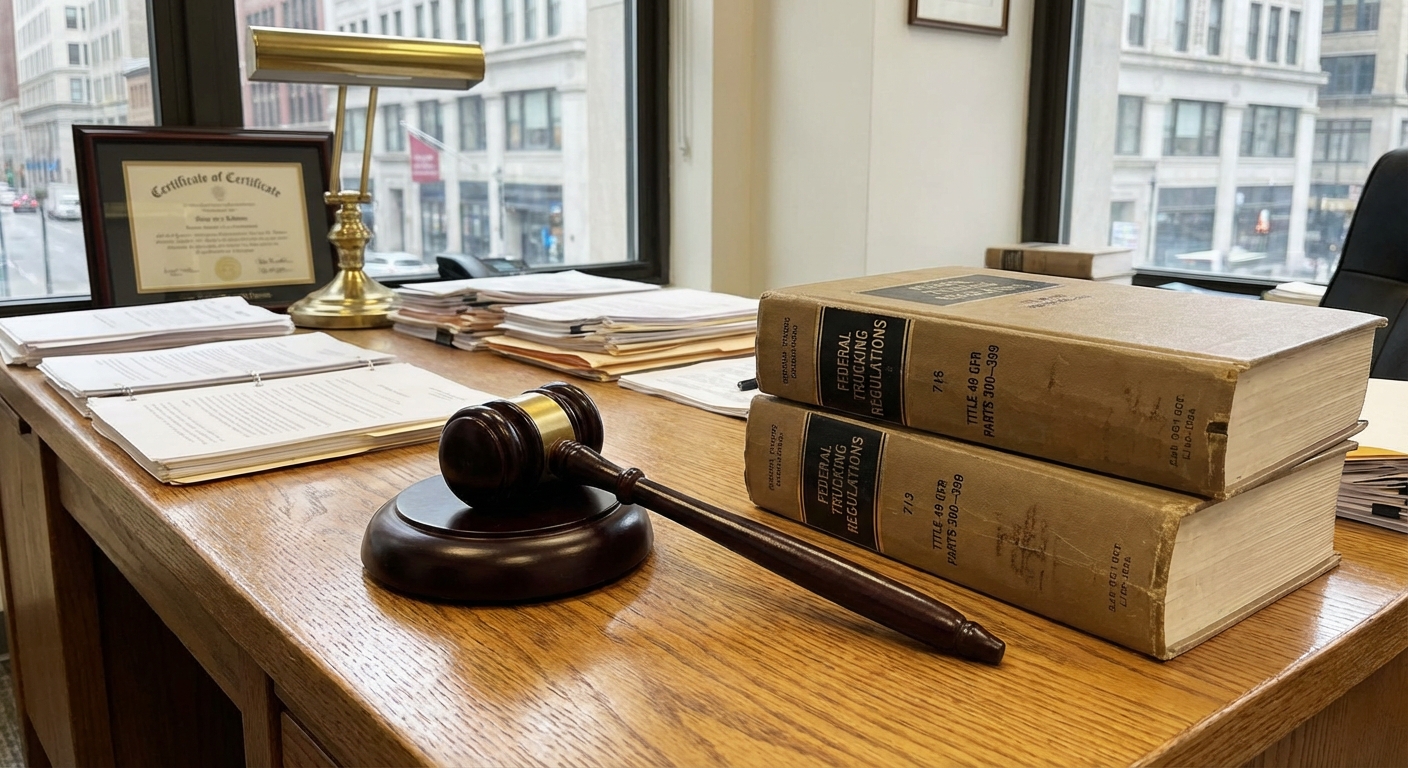
Finding the Right Truck Accident Attorney in Victorville
The best truck accident attorney for your Victorville case understands FMCSA regulations, knows how to extract and preserve evidence from electronic logging devices and dispatch records, and has successfully litigated in San Bernardino County courts. Most truck accidents involve commercial motor vehicles weighing up to 80,000 pounds, which means the injury severity and liability determination differ fundamentally from passenger car crashes. Your attorney needs fluency in the technical evidence—CSA scores, HOS violations, maintenance records, and driver qualification files—that trucking companies will fight hard to suppress. California's pure comparative negligence rule means you can recover even if you're partially at fault, but only if your attorney can prove the motor carrier's breach of federal safety standards or negligent operation. The right lawyer understands both the physics of these crashes and the regulatory environment that governs them.
What Sets Apart a Commercial Truck Accident Specialist
A general personal injury attorney won't understand the regulatory framework that shapes truck accident liability. The best attorneys in this space started their careers around federal motor carrier safety—either as DOT investigators, FMCSA compliance auditors, or insurance defense counsel who saw these cases from the trucking company's playbook.
They know that a motor carrier's CSA score is a public record. If the score exceeds the intervention threshold in unsafe driving, improper hours of service, or vehicle maintenance, that score becomes the foundation for a direct negligence claim against the carrier itself, separate from the individual driver's liability. They understand that an ELD malfunction or a falsified HOS log is evidence of systemic neglect, not an isolated driver error.
They also understand the preservation timeline. Under federal rules and California law, a motor carrier must preserve evidence—including electronic data—once they receive notice of a potential lawsuit. A preservation letter sent immediately after a crash, before you file suit, stops the clock on spoliation. Miss that window and critical data disappears legally.
The right attorney will request the driver's qualification file, the last three DOT physicals, maintenance records, dispatch communications, and the full ELD dataset spanning at least 30 days before the crash. These documents tell the real story of how the crash happened.
Understanding the Evidence That Wins Truck Accident Cases
Commercial truck crashes leave a documentary trail. Unlike passenger vehicle accidents, there's a regulatory apparatus that mandates certain records exist and be preserved.
Electronic Logging Device (ELD) Data. Every Class 8 truck operating in interstate commerce must use an ELD to record hours of service. If the driver was in hour 12 of operation when the crash occurred, that's a federal HOS violation and strengthens your negligence claim. The ELD data is timestamped and difficult to falsify, making it powerful evidence.
Compliance, Safety, and Accountability (CSA) Score. Check [FMCSA's public CSA database](https://www.fmcsa.dot.gov/safety/data-and-statistics/csa) to pull the motor carrier's score. A high score in unsafe driving, hours-of-service violations, or vehicle maintenance suggests systemic negligence.
Driver Qualification File (DQF). This file contains the driver's hiring records, medical certifications, training records, and prior accidents. If the driver had previous violations or if the carrier failed to pull or review the DQF before hiring, that's negligent hiring.
Maintenance and Inspection Records. Federal regulations require carriers to inspect and maintain their fleet. If the crash involved brake failure, tire failure, or steering issues, maintenance records will either show proper upkeep or a pattern of deferred maintenance.
Dispatch Communications. Messages between dispatch and the driver, especially those addressing schedule pressure or time-sensitive deliveries, can show that the carrier prioritized speed over safety.
Your attorney must know exactly which records to demand, when to demand them, and how to interpret them once they arrive.
Talk to a truck accident lawyer today
Free consultation — no fees unless your case wins.
Get started →California Comparative Negligence and Settlement Strategy
California follows pure comparative negligence. That means you can recover damages even if you're 99% at fault—the other party simply pays their percentage. However, the defendant's insurance company will argue that you bear a significant portion of fault to reduce what they pay.
In a truck accident, the comparative negligence analysis hinges on whether the motor carrier or driver breached federal safety standards. If the driver was operating in violation of federal HOS rules, or if the truck failed a required safety inspection, the carrier's negligence is easier to prove and the jury's sympathy typically shifts in your direction.
San Bernardino County juries are familiar with trucking. The I-15 corridor runs through the region and commercial traffic is constant. A jury here understands the danger these vehicles pose and typically holds motor carriers to a high standard of care. An attorney with experience in San Bernardino County courtrooms knows how local jurors weigh evidence and how to frame the carrier's failures in language they understand.
The settlement strategy in truck accident cases differs from passenger car cases because the damages are usually much higher. Medical treatment for severe crushing injuries, spinal cord damage, or amputation runs into hundreds of thousands of dollars. Lifetime care, lost wages, and pain and suffering compounds the total. A specialized attorney will demand a settlement that reflects the severity of the injury and the carrier's breach, not settle for the standard formula most adjusters try to apply.
Also, don't assume the motor carrier is the only defendant. The shipper, the broker, the loader, or the trailer owner may share liability depending on the facts. The right attorney investigates all potential defendants.
San Bernardino County Courthouse Experience Matters
Victorville sits in San Bernardino County. Cases file in the San Bernardino County Superior Courthouse. An attorney with courtroom experience in this county knows the judges, the local rules, the pace of discovery, and the jury composition.
San Bernardino County has a mix of urban, suburban, and rural areas. Juries here include agricultural workers, manufacturing employees, and blue-collar professionals—people who understand workplace safety and the dangers of commercial vehicles. They're less swayed by emotional appeals and more persuaded by technical evidence and regulatory violations.
Local counsel also know the county's typical jury awards for catastrophic injury cases. That knowledge informs settlement negotiations. If the defendant's insurer knows that San Bernardino juries consistently award certain ranges for specific injury patterns, they're more likely to settle near those numbers rather than risk trial.
Additionally, San Bernardino County has specific local rules for civil litigation. These rules govern filing deadlines, discovery timelines, and trial procedures. A local attorney navigates these without delay; an out-of-county attorney risks missed deadlines and procedural missteps.
For truck accident cases specifically, the county's proximity to major trucking corridors (I-15, I-40, US-395) means judges here see these cases regularly. They're less likely to be swayed by arguments that might work in other counties, and more likely to focus on the technical facts and regulatory compliance.
How to Evaluate and Choose Your Truck Accident Attorney
Ask specific questions that reveal whether the attorney has real commercial trucking expertise.
Question 1: "Can you explain what a CSA score is and how it figures into my case?" A specialist will explain that it's the FMCSA's safety rating system, describe the intervention thresholds, and explain how a high score creates liability. A general attorney will fumble or give a vague answer.
Question 2: "What will you request in discovery to preserve the defendant's ELD data?" The answer should include a detailed preservation letter, specific requests for the data in its native format, and an explanation of why the timestamp and geolocation data matter. If they say "we'll get the usual discovery," that's a red flag.
Question 3: "Have you handled cases in San Bernardino County Superior Court?" Check their trial record in this specific county, not just their general experience. A lawyer with five trials in San Bernardino County knows the system. A lawyer with five trials in other counties doesn't.
Question 4: "What's your typical case resolution timeline for catastrophic injury cases?" Honest answers acknowledge that complex truck accident cases take 2-4 years. Anyone promising faster resolution either oversimplifies or is pushing you toward a low settlement.
Question 5: "How do you handle non-settling cases? What's your trial record?" Insurance companies negotiate harder when they know the attorney has actually won at trial. A lawyer with zero trial experience has zero leverage.
Also verify the attorney is in good standing with the [State Bar of California](https://www.calbar.ca.gov/) and check their disciplinary history. Maintain updated knowledge of federal motor carrier regulations. The FMCSA updates compliance standards periodically. An attorney who practices in this space regularly attends continuing legal education on trucking law.
Finally, interview at least two attorneys before deciding. The first consultation is usually free. Use it to assess technical knowledge, not personality. Personality doesn't win cases; evidence and strategy do.
Common questions
How do I know if an attorney has genuine commercial trucking experience?
Ask them to explain CSA scores, ELD data, and FMCSA regulations without reading notes. A specialist speaks this language naturally. Also request their trial record in San Bernardino County courts specifically, and ask for references from prior clients in serious injury cases. Generalists often claim they handle truck cases, but specialists can cite specific wins and detailed technical knowledge.
What's the first thing my attorney should do after I hire them?
Send a preservation letter to the motor carrier, the broker, and any other defendants, demanding preservation of all evidence including ELD data, maintenance records, dispatch communications, and the driver's qualification file. This stops the clock on legal spoliation. Delays cost critical evidence. The second step is requesting the driver's DOT physicals and CSA score to assess direct carrier liability.
How long do truck accident cases take in San Bernardino County?
Catastrophic injury cases typically take 18-36 months from filing to settlement or trial. Liability is usually clear quickly once discovery reveals ELD and maintenance data, but damages disputes—medical causation, future care costs, earning capacity—drive the timeline. Cases with clear regulatory violations settle faster; cases requiring expert testimony on impact dynamics or medical prognosis take longer.
What's a typical settlement range for a serious truck accident in Victorville?
That depends entirely on injury severity, liability clarity, and the motor carrier's insurance limits. A case with clear HOS violations, permanent disability, and six-figure medical bills might range from five hundred thousand to several million dollars or higher. Insurance limits matter too—many carriers carry limited per-incident limits, which caps recovery even if damages are larger. Your attorney should investigate the defendant's policy limits early.
Does California's comparative negligence rule hurt my case if I'm partially at fault?
No. California's pure comparative negligence means you recover your percentage of fault even if you're 90% at fault. The defendant pays their share. However, adjusters will inflate your percentage to reduce payouts. That's where specialized representation matters—an attorney who can prove the motor carrier's federal safety violations positions your case so the jury assigns minimal fault to you, regardless of your actual conduct.
What if the motor carrier is insured by a captive or self-insured program?
Self-insured carriers often carry higher policy limits and have more incentive to settle quickly to avoid regulatory scrutiny. However, they also employ sophisticated defense counsel who know how to suppress evidence and challenge damages. Representation by an attorney with experience against self-insured carriers is critical—they understand the political and financial dynamics that drive settlement negotiations at that level.
Experienced truck accident attorneys. No upfront cost.
Free consultation →